There’s something quietly mesmerizing about the way Turkish Delight, or Lokum, melts on your tongue—just a gentle, fragrant sweetness that lingers without overwhelming. I first stumbled upon this perfect Turkish Delight recipe on a quiet Sunday afternoon, of all times, while rummaging through an old cookbook I’d inherited from a dear friend who had traveled extensively in the Middle East. Honestly, I wasn’t expecting much. I mean, who has time to make candy from scratch, right? But the aroma of rosewater and citrus simmering on the stove pulled me in. That moment—the kitchen filled with a sweet, floral scent and the soft, sticky texture of the candy settling in the pan—was oddly calming.
What surprised me most was how approachable this authentic Lokum recipe turned out to be. No fancy equipment, no complicated steps, just patience and a bit of stirring. It became my little weekend ritual, a way to slow down and appreciate something simple but special. Over time, friends started asking for the recipe after tasting it at casual get-togethers. It’s funny how a humble treat like this can spark so many conversations and smiles.
So, this isn’t just a recipe; it’s a tiny tradition that reminds me of quiet afternoons, warm cups of tea, and those unexpected moments of joy that come from making something by hand. If you’ve ever been curious about Turkish Delight or wondered how to make your own authentic batch, this recipe will gently guide you there. It’s sweet bliss, no fuss, no frills—just pure, chewy magic.
Why You’ll Love This Recipe
After several trials and tweaks, this perfect Turkish Delight recipe stands out for so many reasons. It’s not just about making candy; it’s about capturing a centuries-old tradition in your own kitchen, with ingredients you can trust and steps you can follow without stress.
- Quick & Easy: This recipe comes together in about 2 hours, most of which is simmering and setting time—perfect for a relaxed afternoon project.
- Simple Ingredients: You won’t need anything exotic—just sugar, cornstarch, lemon juice, and rosewater or your favorite flavoring. Pantry staples mostly!
- Perfect for Gifting: Homemade Lokum makes a thoughtful and beautiful gift for holidays, birthdays, or just because. People always ask for more.
- Crowd-Pleaser: Whether you’re serving it to family, friends, or guests unfamiliar with Turkish sweets, this recipe tends to win hearts every time.
- Unbelievably Delicious: The soft, chewy texture combined with the delicate floral or citrus notes brings a comforting yet exotic feel that keeps you reaching for just one more piece.
What sets this recipe apart is the balance of traditional technique with a straightforward approach. I’ve tested it multiple times, tweaking the simmering time and the amount of rosewater to get that perfect chew without stickiness. Plus, instead of the usual powdered sugar coating, this version uses a light dusting of cornstarch and powdered sugar for a clean bite. It’s not just another candy recipe—it’s the best version I’ve found for authentic Turkish Delight at home.
Honestly, it’s the kind of recipe that makes you pause and savor the moment—like a little sweet escape that feels both familiar and a bit magical.
What Ingredients You Will Need
This recipe uses simple, wholesome ingredients to deliver that classic Turkish Delight flavor and texture without fuss. Most are pantry staples, and substitutions are easy if needed.
- Granulated Sugar (2 cups / 400 g) – The base sweetness, make sure it’s fine and fresh for a smooth melt.
- Water (1 1/4 cups / 300 ml) – Divided for sugar syrup and cornstarch mixture.
- Cornstarch (1 cup / 120 g) – For thickening and creating the signature chewiness. Look for a fine, clump-free brand like Argo.
- Lemon Juice (1 tablespoon / 15 ml) – Adds just the right acidity to balance sweetness and helps prevent crystallization.
- Rosewater (1-2 tablespoons / 15-30 ml) – The classic flavor, but orange blossom water or vanilla extract works beautifully too.
- Powdered Sugar (for dusting, about 1/2 cup / 60 g) – Mix with cornstarch to coat the final cubes and keep them from sticking.
- Optional: Chopped pistachios, walnuts, or dried rose petals (1/4 cup / 30 g) – For a delightful texture and visual appeal.
If you’re aiming for a gluten-free or vegan version, this recipe fits perfectly as is. For a twist, I sometimes swap cornstarch with arrowroot powder, though the texture changes slightly. When I can find fresh rosewater at a Middle Eastern market, I grab it, but the bottled kind from the spice aisle works just fine. Just a heads-up: too much rosewater can overwhelm, so start with less and add more after tasting the syrup.
Equipment Needed
You won’t need anything fancy, which is part of why this recipe is so approachable. Here’s what I use and recommend:
- Medium saucepan: A heavy-bottomed one (about 2-quart / 2-liter) to prevent burning the sugar syrup.
- Whisk and wooden spoon: For stirring the syrup and cornstarch mixture smoothly.
- Measuring cups and spoons: Precision matters here, so I prefer using digital kitchen scales for best results.
- 8×8-inch (20×20 cm) square baking pan: For setting the Lokum. Line with parchment paper for easy removal.
- Fine mesh sieve: To dust the powdered sugar and cornstarch evenly over the cubes.
If you don’t have a square pan, a similar-sized round or rectangular pan works, just adjust the thickness accordingly. I once used a silicone mold, but it was tricky to unmold without tearing the candy. Heavy-bottom pots help avoid hot spots and burning, which can happen if the sugar syrup isn’t monitored closely. Overall, these tools keep the process straightforward and fuss-free.
Preparation Method
- Prepare your pan: Line the 8×8-inch pan with parchment paper and lightly dust it with a mix of powdered sugar and cornstarch to prevent sticking. Set aside. (5 minutes)
- Make the sugar syrup: In your medium saucepan, combine 1 cup (200 g) granulated sugar with 1/2 cup (120 ml) water and the lemon juice. Stir gently to combine, then bring to a boil over medium heat without stirring. Use a candy thermometer to monitor the temperature, and let it reach 240°F (115°C), the soft-ball stage. This usually takes about 10-15 minutes. Remove from heat immediately to avoid burning.
- Prepare the cornstarch mixture: While the syrup is heating, whisk together 1 cup (120 g) cornstarch, 1/2 cup (120 ml) water, and the remaining 1 cup (240 ml) water in a separate saucepan. Stir continuously over medium heat until it thickens into a smooth, gluey paste—about 10 minutes. It should be glossy and elastic, not grainy.
- Combine syrup and cornstarch: Slowly pour the hot sugar syrup into the cornstarch mixture, stirring constantly with a wooden spoon or whisk. Return the saucepan to low heat and cook, stirring frequently, for 30-40 minutes. The mixture will become increasingly thick and sticky—almost like a thick jelly. This step is key for that perfect chewiness, so patience is your friend here.
- Add flavoring: Remove from heat and stir in your rosewater (or alternative flavor). If you want to add nuts or dried petals, fold them in now. The texture will be thick but spreadable.
- Set the Lokum: Pour the mixture into your prepared pan, smoothing the top with a spatula. Let it cool uncovered at room temperature for several hours or overnight until fully set and firm to the touch.
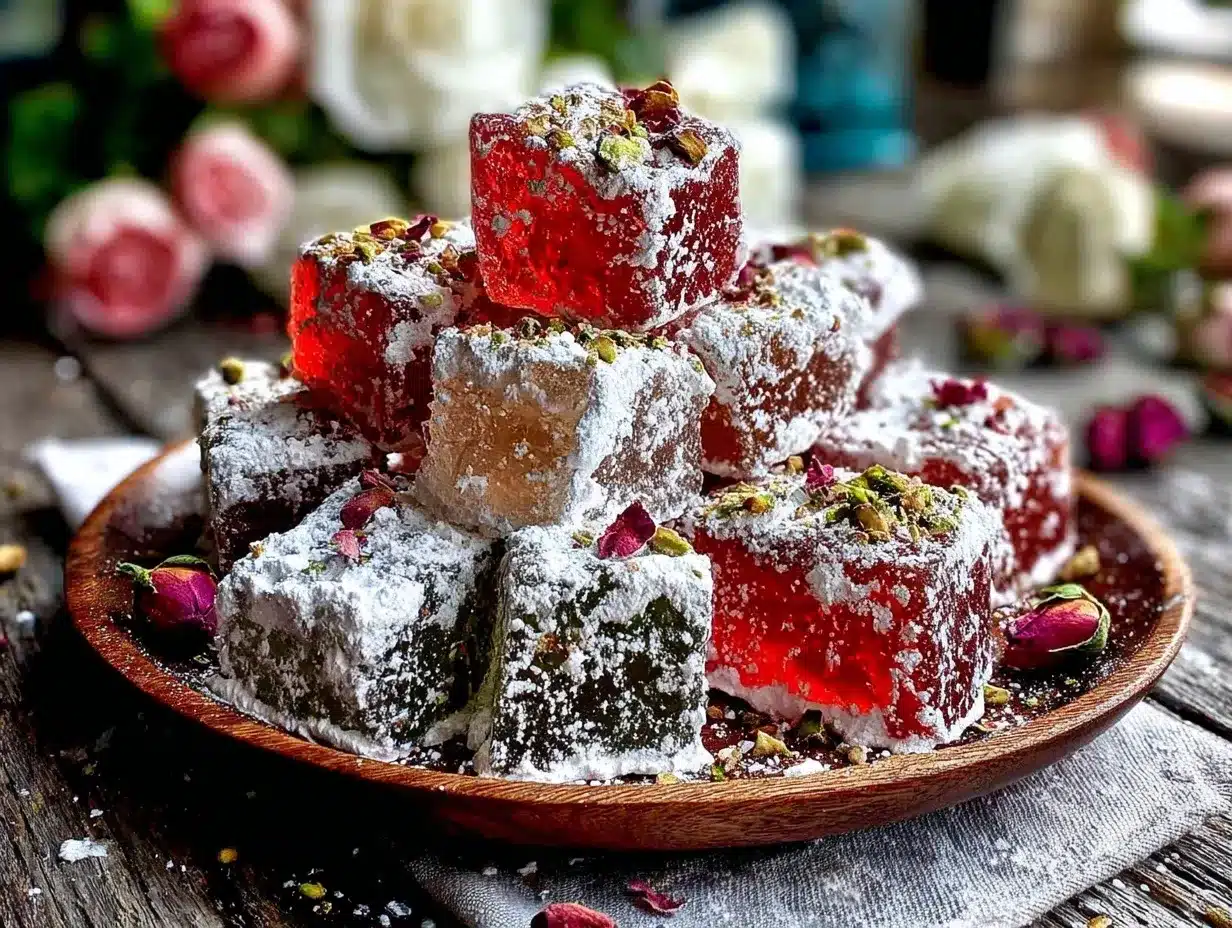
- Cut and coat: Once set, dust a clean surface with the powdered sugar and cornstarch mix. Turn the Lokum out onto the surface, peel off the parchment paper, and cut into small cubes with a sharp knife dusted with the coating mixture. Toss cubes gently in the powdered sugar blend to coat all sides and prevent sticking.
- Store: Store your Turkish Delight in an airtight container at room temperature for up to two weeks. Avoid refrigeration, which can dry it out.
Pro tip: Use a sharp serrated knife for cleaner cuts, and dust your knife with the powdered sugar mixture between slices to avoid sticky messes. If your Lokum seems too soft after cooling, give it a bit more time—it firms up as it rests.
Cooking Tips & Techniques
Making Turkish Delight is as much about technique as it is about ingredients. Here are some tips I’ve picked up through trial and error:
- Temperature control is everything: Use a reliable candy thermometer. If your syrup doesn’t reach the soft-ball stage, the Lokum won’t set properly. Too hot, and it’ll be brittle.
- Stir gently and consistently: The cornstarch mixture can clump if you rush. Keep the heat moderate and stir often to avoid lumps.
- Don’t rush the setting process: Lokum takes its time to develop that perfect texture. Patience here pays off big time.
- Flavor balance: Too much rosewater or lemon juice can overpower. Start with less and add more after tasting the syrup if needed.
- Coating mix: A 1:1 ratio of powdered sugar and cornstarch works best to keep cubes from sticking without being overly powdery.
One time, I skipped the lemon juice and ended up with a grainy mess because the sugar crystallized too soon. Lesson learned! Also, stirring with a wooden spoon helps you feel the thickening texture better than a whisk. Multitasking here is doable—while the Lokum sets, I usually prep tea or clean up. Just don’t forget about that thickening step, or it can catch and burn quickly.
Variations & Adaptations
This recipe is a great base for a few fun spins depending on your taste, dietary needs, or occasion:
- Nutty Delight: Add 1/4 cup (30 g) chopped pistachios or walnuts for a lovely crunch and color contrast.
- Chocolate Lokum: Mix in 2 tablespoons (15 g) unsweetened cocoa powder with the cornstarch paste for a rich, chocolaty twist.
- Fruit-Flavored: Substitute rosewater with 1 tablespoon (15 ml) pomegranate molasses or orange blossom water. You can also fold in small pieces of dried fruit.
- Vegan Version: This recipe is naturally vegan, but watch your flavorings—some rosewaters have additives. Use organic or verified vegan brands.
- Gluten-Free: Cornstarch is naturally gluten-free, so no adjustments needed here.
Personally, I once tried adding lavender instead of rosewater, and while it was interesting, it’s a bit more floral and less traditional. If you like experimenting, start with small batches to see what suits your palate.
Serving & Storage Suggestions
Serve your Turkish Delight at room temperature, ideally alongside a cup of strong black tea or Turkish coffee. The bitterness of the coffee cuts through the sweetness beautifully. Arrange cubes on a decorative plate dusted lightly with extra powdered sugar for a pretty presentation.
For storage, keep Lokum in an airtight container at room temperature. Avoid refrigeration, which can dry out the candy and make it tough. It keeps well for up to two weeks but honestly, it rarely lasts that long in my kitchen.
If you need to re-soften slightly hardened Lokum, let it sit at room temperature for a few hours. The flavors and texture actually deepen a bit after a day or two, so it’s a nice treat that gets better with a little patience.
Nutritional Information & Benefits
Each serving of Turkish Delight (about 3 pieces or 30 g) roughly contains:
| Calories | 110 |
|---|---|
| Carbohydrates | 28 g |
| Sugars | 22 g |
| Fat | 0 g |
| Protein | 0 g |
While Turkish Delight is mostly sugar, rosewater offers mild antioxidant properties, and the lemon juice adds a touch of vitamin C. It’s a gluten-free treat that fits nicely into occasional indulgences. For those mindful of sugar intake, smaller portions or sharing is the way to go.
From a wellness perspective, making this candy at home means you control the ingredients—no artificial colors or preservatives, just simple, natural flavors. That’s something I appreciate, especially after trying store-bought versions that can be a bit harsh or overly sweet.
Conclusion
This perfect Turkish Delight recipe is one of those rare finds that feels both special and accessible. It’s sweet and chewy with just the right balance of floral and citrus notes—a true taste of tradition that you can make in your own kitchen without stress.
Feel free to tweak the flavors or add nuts to suit your style. Honestly, I love this recipe because it’s become my little homemade luxury, a reminder that simple ingredients and a bit of patience can lead to sweet moments worth savoring.
If you try it, I’d love to hear how you made it your own. Sharing these small joys keeps the tradition alive, one chewy cube at a time.
FAQs
What is the best way to store Turkish Delight?
Store it in an airtight container at room temperature, dusted with powdered sugar and cornstarch, for up to two weeks. Avoid refrigeration to keep it soft.
Can I use a different flavor instead of rosewater?
Yes! Orange blossom water, vanilla extract, or even pomegranate molasses are great alternatives that add unique twists.
Why did my Turkish Delight turn out grainy?
This usually happens if the sugar syrup didn’t reach the correct temperature or if lemon juice was skipped. Using a candy thermometer and including acid helps prevent crystallization.
Is Turkish Delight gluten-free?
Yes, traditional Turkish Delight made with cornstarch is naturally gluten-free, making it suitable for those avoiding gluten.
Can I make Turkish Delight without a candy thermometer?
It’s tricky but possible by testing the syrup with the soft-ball method: drop a bit of syrup into cold water and see if it forms a soft, pliable ball. However, a candy thermometer improves accuracy and results.
Pin This Recipe!
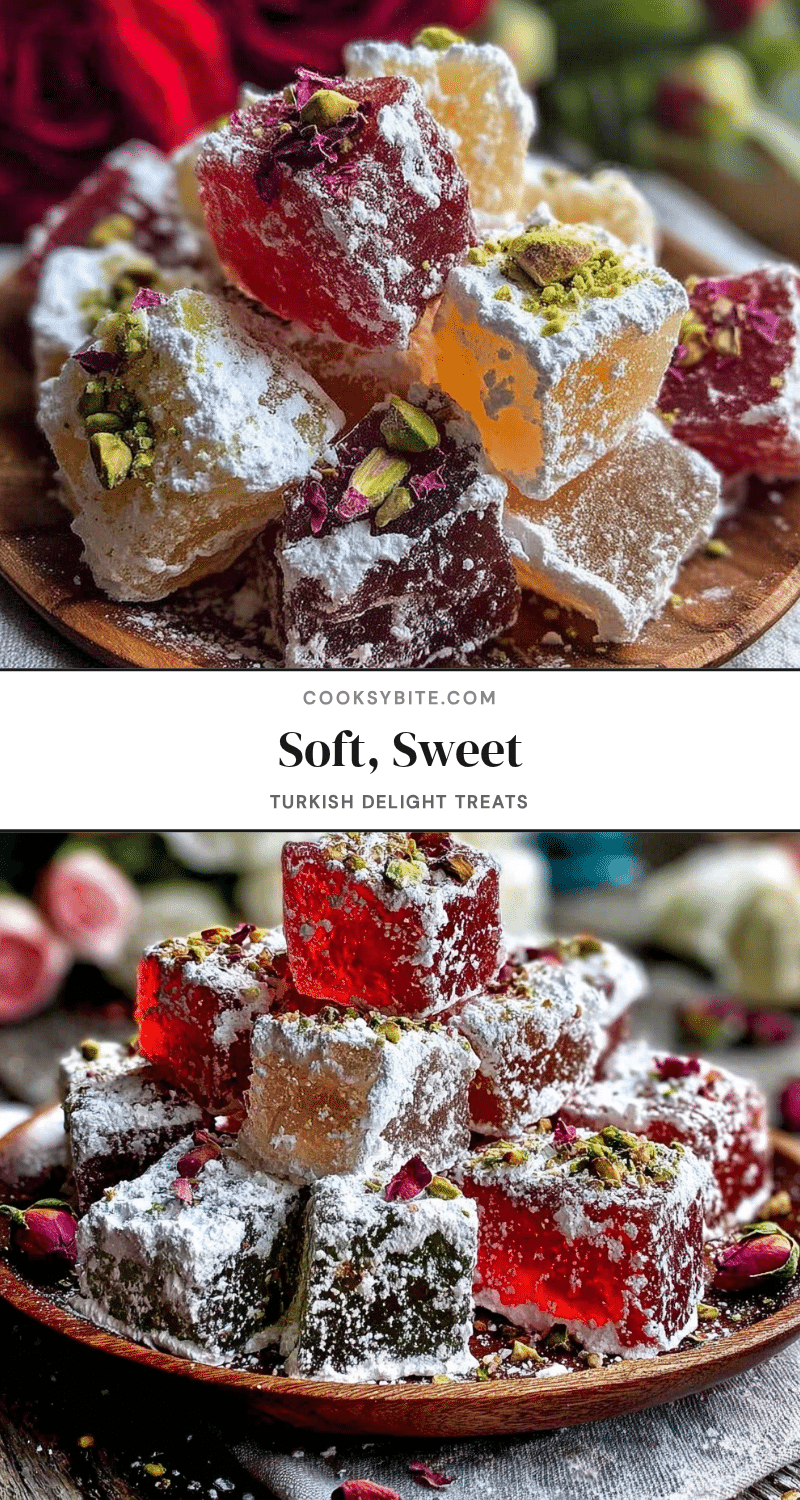
Perfect Turkish Delight Recipe Easy Authentic Lokum for Sweet Bliss
An authentic and easy Turkish Delight (Lokum) recipe that delivers soft, chewy candy with delicate floral and citrus notes, perfect for gifting or enjoying with tea.
- Prep Time: 15 minutes
- Cook Time: 1 hour 45 minutes
- Total Time: 2 hours
- Yield: About 36 cubes (approx. 12 servings) 1x
- Category: Dessert
- Cuisine: Turkish
Ingredients
- 2 cups (400 g) granulated sugar
- 1 1/4 cups (300 ml) water, divided
- 1 cup (120 g) cornstarch
- 1 tablespoon (15 ml) lemon juice
- 1–2 tablespoons (15–30 ml) rosewater (or orange blossom water, vanilla extract)
- 1/2 cup (60 g) powdered sugar (for dusting)
- Optional: 1/4 cup (30 g) chopped pistachios, walnuts, or dried rose petals
Instructions
- Line an 8×8-inch (20×20 cm) square baking pan with parchment paper and lightly dust with a mix of powdered sugar and cornstarch. Set aside.
- In a medium saucepan, combine 1 cup (200 g) granulated sugar, 1/2 cup (120 ml) water, and lemon juice. Stir gently and bring to a boil over medium heat without stirring. Use a candy thermometer to reach 240°F (115°C), the soft-ball stage. Remove from heat immediately.
- In a separate saucepan, whisk together 1 cup (120 g) cornstarch, 1/2 cup (120 ml) water, and the remaining 1 cup (240 ml) water. Stir continuously over medium heat until thick and glossy, about 10 minutes.
- Slowly pour the hot sugar syrup into the cornstarch mixture, stirring constantly. Return to low heat and cook, stirring frequently, for 30-40 minutes until thick and sticky.
- Remove from heat and stir in rosewater or alternative flavoring. Fold in nuts or dried petals if using.
- Pour mixture into prepared pan, smooth the top, and let cool uncovered at room temperature for several hours or overnight until firm.
- Dust a clean surface with powdered sugar and cornstarch mix. Turn Lokum out, peel off parchment, and cut into small cubes with a knife dusted with the coating mixture.
- Toss cubes gently in the powdered sugar blend to coat all sides and prevent sticking.
- Store in an airtight container at room temperature for up to two weeks. Avoid refrigeration.
Notes
Use a candy thermometer to ensure syrup reaches the soft-ball stage (240°F/115°C) to avoid grainy texture. Stir gently and consistently to prevent lumps. Dust knife with powdered sugar mixture between cuts for clean slices. Avoid refrigeration to keep Lokum soft. Let set overnight for best texture. Adjust rosewater amount to taste to avoid overpowering flavor.
Nutrition
- Serving Size: 3 pieces (30 g)
- Calories: 110
- Sugar: 22
- Carbohydrates: 28
Keywords: Turkish Delight, Lokum, rosewater candy, homemade candy, Middle Eastern sweets, gluten-free dessert, vegan candy, easy Turkish Delight