Introduction
I still remember the night I first attempted these perfect French macarons. It was one of those rare, quiet evenings where the house had settled into silence, except for the soft hum of the oven. Honestly, I wasn’t expecting much—macarons have a reputation for being finicky little things that can easily turn into crunchy disasters or hollow shells. But after a few tries, something clicked. The shells emerged from the oven with that ethereal, delicate texture I’d been chasing, thin crisp exteriors giving way to soft, chewy centers. The scent was subtle but unmistakably sweet and almondy, filling the kitchen with a gentle warmth.
It was during that calm moment, with the small batch cooling on the rack, that I realized these macarons weren’t just a fancy treat—they were a kind of comforting challenge, a quiet victory in the kitchen. I’d never been a “baker” type, and yet here I was, proud to call these my own. The recipe stuck with me because it felt approachable, even when others seemed daunting. And honestly, now I find myself making them multiple times a week, tweaking fillings or trying new colors just for the simple joy of it. This recipe delivers that delicate, light texture every time, and I’m confident it will for you too.
Why You’ll Love This Recipe
- Quick & Easy: Comes together in about 45 minutes of active prep time, perfect for squeezing in on a weekend afternoon or a spontaneous baking session.
- Simple Ingredients: Uses pantry staples like almond flour, powdered sugar, and egg whites—no exotic items needed.
- Perfect for Special Occasions: Ideal for tea parties, birthdays, or as elegant homemade gifts that impress without stress.
- Crowd-Pleaser: Everyone from kids to adults raves about the delicate crunch and melt-in-your-mouth texture.
- Unbelievably Delicious: The balance of sweet, nutty shells paired with creamy fillings is next-level indulgence.
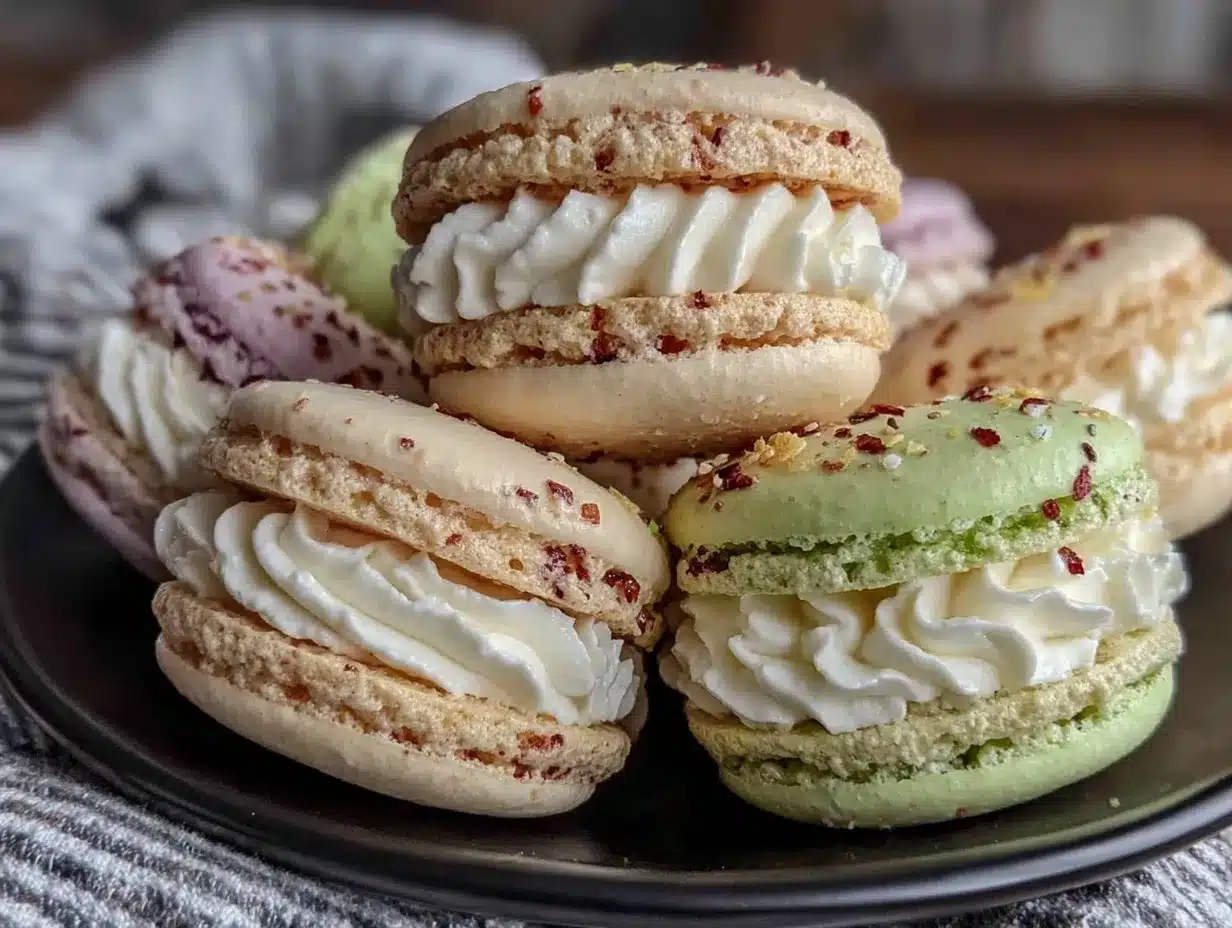
What sets this recipe apart is the technique I’ve refined after several batches—especially the gentle folding method that gives the batter just the right flow, leading to smooth, shiny shells with those coveted “feet.” I also recommend letting the shells rest before baking; it’s a game changer for texture, creating that delicate outer crust without cracks. This isn’t just another macaron recipe; it’s one that makes you pause and savor that first bite, feeling the lightness and subtle chew you thought only pastry chefs could achieve. It’s comfort food in an elegant form, perfect for both impressing guests and indulging yourself.
What Ingredients You Will Need
This recipe uses simple, wholesome ingredients to deliver bold flavor and that satisfying light texture without fuss. Most are pantry staples, and you can easily swap a few to suit dietary needs or preferences.
- Almond flour: 1 cup (100g), finely ground and sifted for smooth shells. I prefer Blue Diamond for consistent texture.
- Powdered sugar: 1 ¾ cups (210g), sifted to keep the batter airy and prevent lumps.
- Egg whites: 3 large (about 90g), aged for 1-2 days in the fridge to improve stability and volume.
- Granulated sugar: ⅓ cup (65g), to stabilize the meringue and add sweetness.
- Vanilla extract: 1 teaspoon, pure and high-quality (like Nielsen-Massey) adds a subtle floral note.
- Optional food coloring: gel or powdered, to tint shells without adding extra liquid.
- For the filling: buttercream, ganache, or jam—choose your favorite. I love a classic chocolate ganache or raspberry buttercream for contrast.
Substitution tips: Use superfine almond flour for the best texture. For a gluten-free option, this recipe works perfectly as is. If you prefer dairy-free, swap butter in the filling for coconut oil or a plant-based alternative. Freshly ground almonds can be used but expect a slightly coarser shell. And if you want to try different flavors, almond extract can replace vanilla, or add a pinch of citrus zest to the filling for brightness.
Equipment Needed
- Electric mixer: Stand or hand mixer for whipping egg whites into stiff peaks. A stand mixer (like KitchenAid) makes it smoother but hand mixers work fine.
- Sifter or fine mesh sieve: Essential for sifting almond flour and powdered sugar to avoid lumps and ensure smooth batter.
- Mixing bowls: Glass or metal preferred, as plastic can hold grease and hinder meringue formation.
- Spatula: Flexible silicone for folding batter gently without deflating it.
- Piping bag and round tip (about ½ inch): For shaping uniform shells. If you don’t have a piping bag, a zip-top bag with a corner snipped works in a pinch.
- Baking sheets and parchment paper or silicone mats: Non-stick surfaces prevent sticking and help create smooth bottom shells.
- Oven thermometer: Optional but helpful to monitor precise baking temperature (ideal is 285°F / 140°C).
Personally, I find using a stand mixer cuts down on prep time and gives a more stable meringue, but I’ve had success with a trusty hand mixer too. Keeping bowls spotless and grease-free is crucial—grease is a macaron’s worst enemy. Investing in quality piping tips and silicone mats pays off in shell consistency and cleanup ease.
Preparation Method
- Prep your dry ingredients: Sift 1 cup (100g) almond flour and 1 ¾ cups (210g) powdered sugar together into a large bowl. This step is key to removing lumps and ensuring smooth shells. Set aside.
- Whip the egg whites: In a clean, grease-free bowl, beat 3 large aged egg whites on medium speed until foamy (about 1-2 minutes). Gradually add ⅓ cup (65g) granulated sugar while increasing to high speed. Beat until stiff, glossy peaks form (about 5-7 minutes). You’ll know it’s ready if the meringue holds sharp peaks and doesn’t slide when you tilt the bowl.
- Fold dry ingredients into meringue: Add the sifted almond flour mixture to the meringue in three additions. Use a flexible spatula to fold gently but thoroughly, turning the bowl as you go. The batter should slowly flow off the spatula in a thick ribbon after about 50-60 folds. Be careful not to overmix—it’s a fine balance between aeration and fluidity.
- Add flavor and color: Fold in 1 teaspoon vanilla extract and any gel food coloring at this stage. Avoid liquid colorings as they can alter batter consistency.
- Pipe the shells: Transfer batter to a piping bag fitted with a ½-inch round tip. Pipe 1.5-inch (4 cm) circles onto baking sheets lined with parchment or silicone mats, spacing about 1 inch apart. Tap the tray firmly on the counter twice to release air bubbles.
- Rest the shells: Let the piped shells sit at room temperature for 30-60 minutes, or until a skin forms on the surface. You should be able to lightly touch without batter sticking to your finger. This resting step is essential for developing the signature “feet” during baking.
- Bake: Preheat oven to 285°F (140°C). Bake one tray at a time for 15-18 minutes, rotating halfway through for even cooking. Shells should be dry and crisp on top but still soft inside.
- Cool completely: Let shells cool on the tray for 10 minutes before transferring to a wire rack. Avoid peeling off parchment too soon, or shells may crack.
- Fill and assemble: Pair shells of similar size. Pipe or spread your chosen filling onto one shell, then sandwich with its partner. Refrigerate for 24 hours to allow flavors to meld and texture to soften slightly.
If your shells crack or feet don’t form, check batter consistency and resting time. Sometimes ovens run hot—an oven thermometer can help adjust temps. If meringue falls flat, the bowl or beaters might have had grease. Patience is key, but once you nail these steps, you’ll be rewarded with those delicate, classic macarons.
Cooking Tips & Techniques
Making perfect French macarons is a bit of an art, but a few tips go a long way. First, aging your egg whites in the fridge for a day or two makes them whip up stronger and produces a more stable meringue. Also, always sift your dry ingredients twice if you can—it’s worth the effort for that smooth finish.
Watch your folding technique closely. Folding too little leaves lumps and results in uneven shells, but overfolding makes the batter too runny, causing flat or cracked cookies. The batter should flow slowly like lava—thick but not stiff.
Resting the piped shells is often overlooked but essential. That little skin helps prevent cracks and encourages the feet to rise. If you’re impatient, a fan or open window can speed drying.
Oven temperature is critical. Too hot, and shells brown or crack; too cool, and they won’t develop feet or dry properly. Using an oven thermometer helps keep things steady.
Lastly, don’t rush assembling the macarons. The best texture and flavor come after chilling them for at least 24 hours. I’ve learned the hard way that skipping this step leads to disappointing results.
Variations & Adaptations
This basic recipe is a perfect canvas for creativity. Want to switch things up? Here are some ideas:
- Flavor twists: Add finely ground freeze-dried raspberries to your almond flour for a fruity hue and tang. Or try matcha powder for a subtle green color and earthy flavor.
- Filling swaps: Replace classic buttercream with salted caramel, lemon curd, or even mascarpone mixed with honey for richer fillings.
- Dietary adaptations: For nut allergies, try using sunflower seed flour instead of almond flour, though texture will differ slightly. Vegan options can be tricky but aquafaba (chickpea water) can sometimes replace egg whites with practice.
Personally, I once made lavender-infused white chocolate ganache filling for a tea party, and it was a hit—delicate with a floral note that paired beautifully with the light shells. Don’t hesitate to experiment; macarons respond well to gentle flavor additions without losing their signature texture.
Serving & Storage Suggestions
Serve these perfect French macarons slightly chilled or at room temperature for the best texture. They look stunning arranged on a pretty platter or stacked in a decorative box if gifting. Pair with light teas, coffee, or even a glass of sparkling wine for special occasions.
Store macarons in an airtight container in the refrigerator for up to 5 days. They actually taste better after a day or two as the filling softens the shells. For longer storage, freeze assembled macarons in a sealed container for up to one month. Thaw overnight in the fridge before serving.
When reheating, avoid microwaves as they can melt fillings and ruin texture. Instead, bring them to room temperature slowly. Over time, flavors meld beautifully, making leftovers even more enjoyable.
Nutritional Information & Benefits
Each macaron contains roughly 70-90 calories, depending on filling, and offers a moderate amount of protein from egg whites. Almond flour provides healthy fats, vitamin E, and fiber, while powdered sugar adds sweetness. This recipe is naturally gluten-free and can be adapted for dairy-free diets with alternative fillings.
While macarons are definitely a treat, they can fit into a balanced lifestyle when enjoyed mindfully. I appreciate this recipe for delivering that sophisticated French patisserie experience without excess fuss or overly processed ingredients. It’s a sweet reward that feels a little special but isn’t over the top.
Conclusion
Perfect French macarons with light, delicate texture don’t have to be intimidating. With a bit of patience and attention to detail, you can create these elegant treats right in your kitchen. This recipe has stuck with me because it’s approachable, forgiving, and truly satisfying. Whether you’re baking for yourself, friends, or a special occasion, these macarons bring a little sweetness and a lot of joy.
Feel free to make this recipe your own—try new flavors, colors, or fillings. I’d love to hear how your macarons turn out or any creative spins you come up with. Baking isn’t just about perfection; it’s about finding those moments in the kitchen that make you smile.
FAQs
Why do my macarons crack on top?
Cracking usually means the batter is too dry or the shells didn’t rest long enough before baking. Make sure you let the piped shells sit until a skin forms and check your oven temperature isn’t too high.
Can I use almond meal instead of almond flour?
Almond meal is coarser and can result in rough shells. For best texture, use superfine almond flour and sift it before mixing.
How do I know when the macarons are done baking?
The shells should be dry and crisp to the touch with a smooth, shiny surface. They should easily lift off the parchment without sticking.
Can I make the shells ahead of time?
Yes! You can bake the shells and store them in an airtight container for up to 3 days before filling.
What’s the best filling for macarons?
Classic buttercream or ganache works beautifully, but jams, lemon curd, or even mascarpone mixtures are delicious alternatives depending on your taste.
Pin This Recipe!
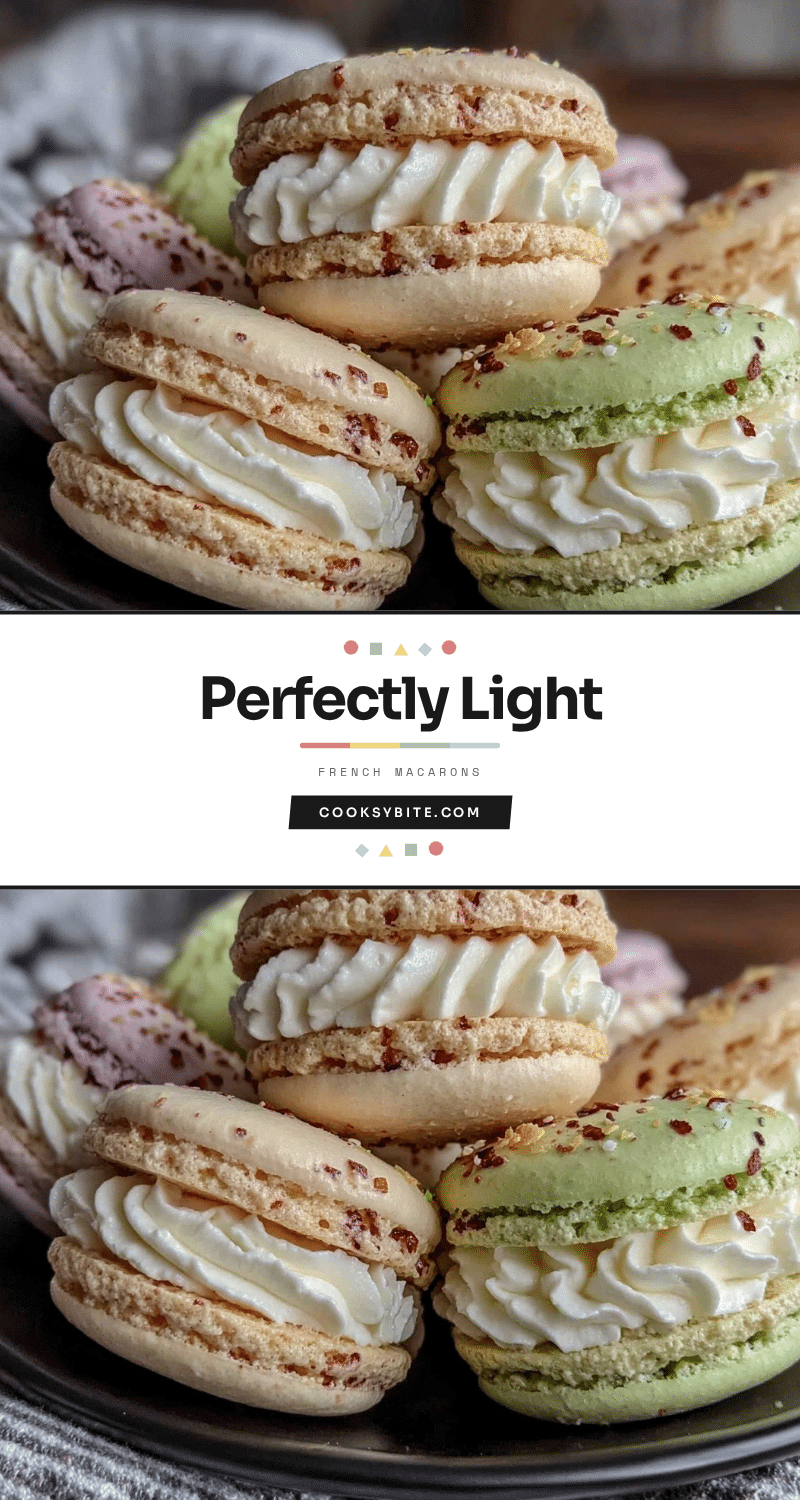
Perfect French Macarons Recipe Easy Homemade Light Delicate Texture

This recipe delivers delicate, light French macarons with thin crisp exteriors and soft, chewy centers. It uses simple pantry ingredients and a refined technique for perfect shells every time.
- Prep Time: 45 minutes
- Cook Time: 15-18 minutes
- Total Time: 1 hour 15 minutes to 1 hour 18 minutes plus 24 hours chilling
- Yield: About 20-24 macarons (depending on size) 1x
- Category: Dessert
- Cuisine: French
Ingredients
- 1 cup (100g) almond flour, finely ground and sifted
- 1 ¾ cups (210g) powdered sugar, sifted
- 3 large egg whites (about 90g), aged 1-2 days in the fridge
- ⅓ cup (65g) granulated sugar
- 1 teaspoon vanilla extract
- Optional gel or powdered food coloring
- Filling of choice: buttercream, ganache, or jam
Instructions
- Sift almond flour and powdered sugar together into a large bowl and set aside.
- In a clean, grease-free bowl, beat egg whites on medium speed until foamy (1-2 minutes). Gradually add granulated sugar while increasing to high speed and beat until stiff, glossy peaks form (5-7 minutes).
- Fold sifted almond flour mixture into the meringue in three additions using a flexible spatula. Fold gently but thoroughly until batter flows slowly off the spatula in a thick ribbon (about 50-60 folds).
- Fold in vanilla extract and any gel food coloring.
- Transfer batter to a piping bag fitted with a ½-inch round tip. Pipe 1.5-inch circles onto baking sheets lined with parchment paper or silicone mats, spacing about 1 inch apart. Tap tray firmly twice to release air bubbles.
- Let piped shells rest at room temperature for 30-60 minutes until a skin forms and batter does not stick to touch.
- Preheat oven to 285°F (140°C). Bake one tray at a time for 15-18 minutes, rotating halfway through. Shells should be dry and crisp on top but soft inside.
- Cool shells on the tray for 10 minutes before transferring to a wire rack.
- Pair shells of similar size, pipe or spread filling on one shell, then sandwich with its partner. Refrigerate assembled macarons for 24 hours to meld flavors and soften texture.
Notes
Age egg whites 1-2 days for better meringue stability. Sift dry ingredients twice for smooth shells. Rest piped shells until a skin forms to develop feet and prevent cracks. Use an oven thermometer to maintain precise temperature. Chill assembled macarons for 24 hours for best texture and flavor. Avoid liquid food coloring to maintain batter consistency.
Nutrition
- Serving Size: 1 macaron
- Calories: 7090
- Sugar: 78
- Sodium: 1015
- Fat: 45
- Saturated Fat: 1.52
- Carbohydrates: 810
- Fiber: 0.51
- Protein: 23
Keywords: French macarons, homemade macarons, almond flour, delicate texture, baking, dessert, light cookies, meringue, easy macarons